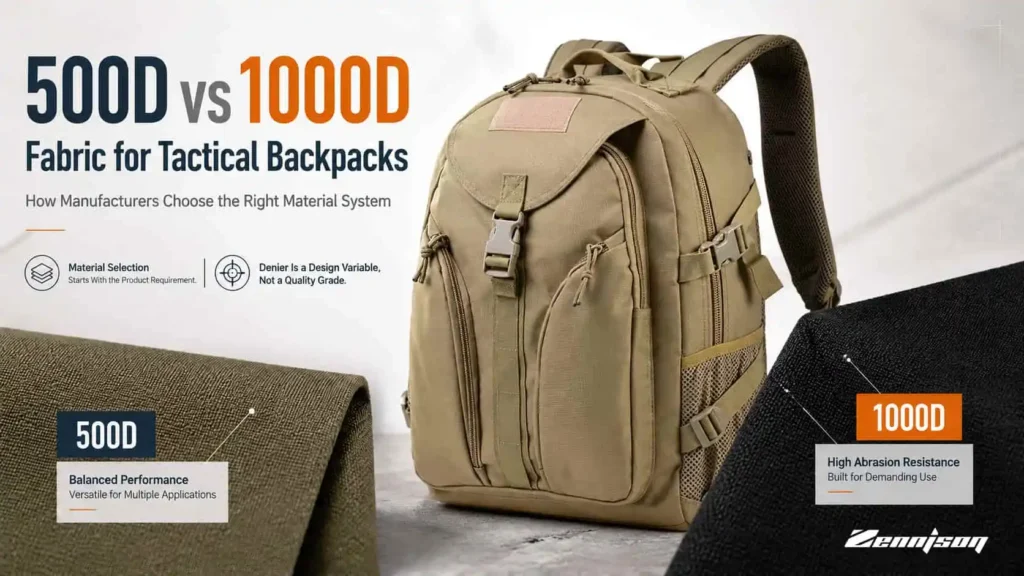
“Should we use 500D or 1000D?” sounds like a precise sourcing question. In practice, it is rarely the first question we need to answer.
At Zennison, we start with the product requirement: What type of backpack are we developing? Where will it be used? How large is it? What load will it carry? What level of water resistance is required? What is the cost target?
Those answers shape the material direction.
A compact tactical daypack, a large load-carrying pack and a conventional commercial backpack do not need the same construction. Even within one backpack, the shell, lining, shoulder system, load-bearing attachments and internal support have different jobs.
Denier matters, but it is one specification inside a larger product architecture. The better question is not simply whether 500D or 1000D is better. It is which combination of materials and construction gives the backpack the right balance of weight, structure, durability, water resistance and cost.
1. We Don’t Start With 500D or 1000D — We Start With the Product Requirement
When a buyer has already specified a fabric, we review it against the design. When no fabric has been specified, we do not automatically select 500D or 1000D.
We begin with six project questions:
- What is the product positioning?
- Where will the backpack be used?
- What are its size and carrying capacity?
- What load is it expected to support?
- What level of water resistance is required?
- What is the target cost?
These questions keep the material decision connected to the finished product.
A heavier shell adds little value if the real weakness is an under-reinforced shoulder-strap root. A highly coated material throughout the pack creates unnecessary stiffness and cost if only the exterior needs that treatment. A premium nylon shell also makes little commercial sense when the product is positioned as a conventional backpack with a tightly controlled cost target.
We define the job first and select the material system second.
If an RFQ says only “tactical backpack in 500D,” many decisions remain open: fiber, weave, coating, lining, reinforcement, webbing and support structure. Those decisions affect both cost and product performance. Denier opens the material discussion; it does not close it.
2. What 500D and 1000D Actually Tell You
The “D” in 500D and 1000D refers to denier, a measure related to the linear mass of the yarn. It gives us information about yarn size, but not the complete finished fabric.
The denier number does not define the fiber, weave, finished weight, coating, hand feel, color process, backing or tested performance. That is why we do not treat 500D and 1000D as universal quality grades.
A higher number is not automatically a better specification. 1000D in the wrong place is still the wrong specification.
When a project requires genuine CORDURA® fabric, we can source the specified material through the appropriate supply channel and incorporate it into the approved product specification.
Whether branded or unbranded, the fabric specification still needs to define its fiber composition, construction, finish, color and product location.
3. Why 600D Polyester, 500D Nylon and 1000D Nylon Are Different Design Choices
In our sourcing discussions, 600D polyester, 500D nylon and 1000D nylon represent different material directions. The numbers do not place them in a quality order.
Does 600D Mean Stronger Than 500D?
Not necessarily.
The denier number describes yarn linear density. Numerically, 600D is higher than 500D, but that does not establish which finished fabric is stronger.
A 600D polyester and a 500D nylon belong to different fiber systems. Their finished performance also depends on fiber and yarn quality, weave, fabric construction, coating and finish. A meaningful comparison therefore starts with two defined fabric specifications—not the numbers 600 and 500 alone.
For a more focused cross-fiber comparison, see our guide to 600D polyester vs 500D nylon for backpacks. It explains why the higher denier number does not automatically mean a stronger finished fabric and what buyers should confirm in the RFQ, BOM and approved sample.
For many conventional backpack projects, 600D polyester is a practical starting point when its construction matches the intended use, product positioning and cost target.
500D nylon is a different design choice. It enters the discussion when the project calls for a nylon-based material system and the finished fabric specification fits the required weight, handling, construction and use environment.
1000D nylon becomes more relevant when the shell itself is expected to face more demanding abrasion, wear or material-strength requirements, and when the added weight and stiffness are acceptable for the product. We still evaluate where it belongs, what job it performs and how the surrounding structure carries load. It is not an automatic full-shell upgrade.
We do not select among these materials by denier alone. We compare the actual fabric specification with the intended product area and the complete backpack design.
Water resistance follows the same logic. It is a system requirement, not a denier decision.
The outer shell might require a water-repellent treatment, coating or specified backing. The lining and organization materials do not automatically need the same treatment. Using one heavy, coated material throughout the pack can make the product stiffer and more expensive without improving the areas that matter most.
Before selecting the material, we need to know where water exposure occurs and what the buyer expects “water resistant” to mean for the finished backpack.
4. A Backpack Is a Material System, Not a Single Fabric
The visible shell is only one part of the backpack.
Depending on the design, the material system includes the shell, lining, mesh, sandwich mesh, EVA or other foam, webbing, binding, reinforcement, support sheets, frame components and hardware.
These components do not need to be equally heavy. They need to work together.
The shell manages exterior exposure and helps create the intended form. Webbing and reinforcement transfer load. Foam, mesh and the support structure shape the back and shoulder system. Binding controls layered edges. Hardware provides adjustment, closure, release or attachment.
The diagram below shows how these materials and components take on different jobs within one backpack.
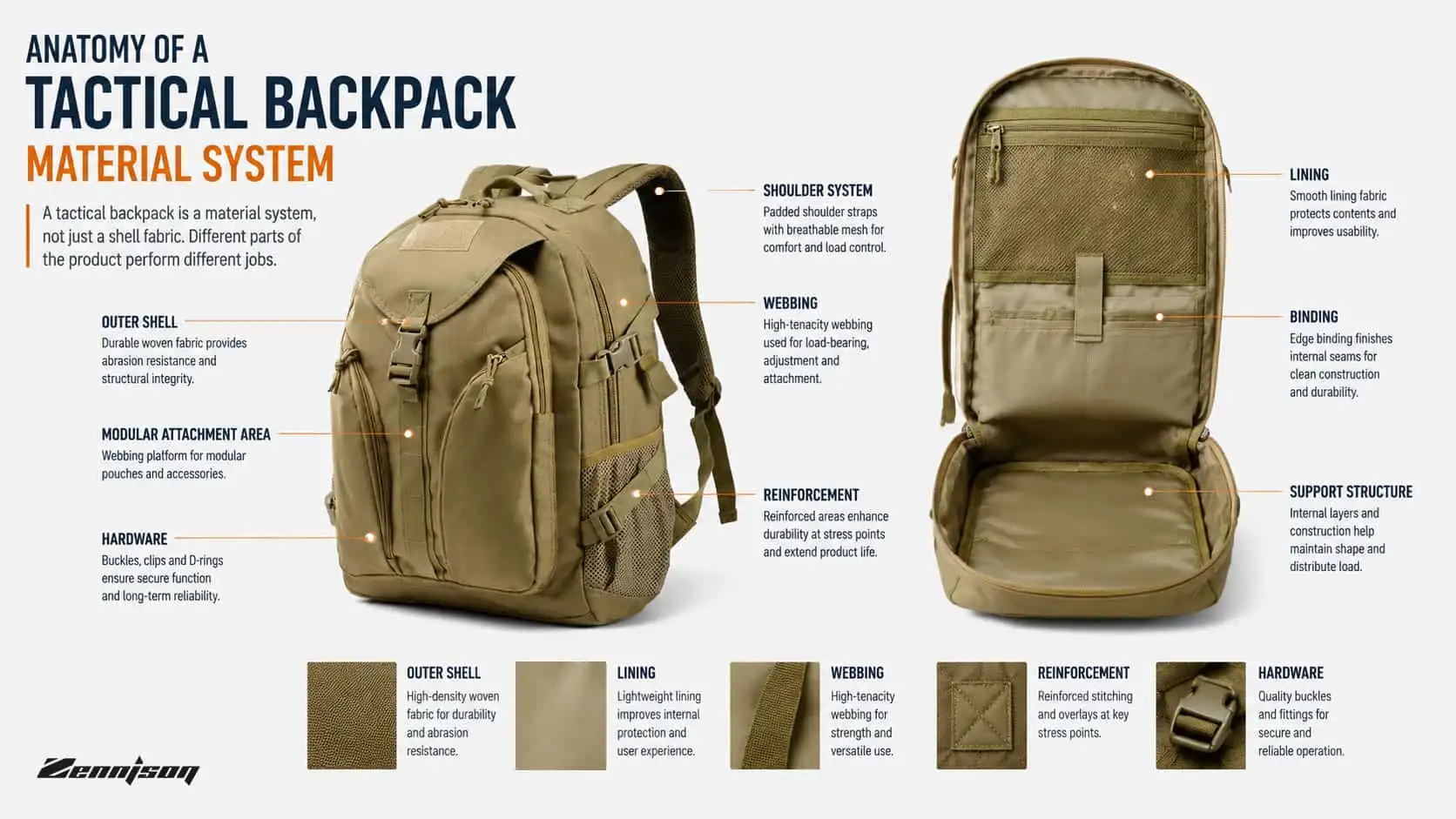
The best material system is not automatically the heaviest one. Making every component heavier can produce a stiff and costly backpack while leaving the real structural risk unresolved.
A heavier shell cannot rescue a weak load path.
Our goal is a purpose-built material system: enough protection and structure where the product needs them, without adding weight, stiffness or cost where they do not improve the design.
5. How We Choose Materials by Product Area
We do not apply a fixed formula such as “500D for the body and 1000D for the bottom.” We evaluate what each area must do.
| Product area | What we evaluate |
|---|---|
| Main shell | Product positioning, pack size, external exposure, required structure, water resistance and cost |
| Base and high-contact areas | Contact and abrasion pattern, corner construction, local overlays and internal support |
| Openings, flaps and gussets | Repeated folding, zipper interaction, seam buildup, stiffness and ease of access |
| Interior and organization | Required protection, compartment structure, weight and whether a coating serves a real purpose |
| Back panel and shoulder system | User contact, padding, ventilation concept, adjustment, support and connection to the pack body |
| Strap roots, handles and modular attachments | Load path, webbing extension, reinforcement area, sewing construction and material layering |
| Support structure and hardware zones | Pack shape, expected load, frame or support requirements and interaction with webbing and surrounding materials |
This approach separates surface requirements from structural requirements.
One backpack base might face repeated abrasion. Another might be protected by its shape, internal support or a separate overlay. One opening needs flexibility around a zipper; another needs more structure. The correct material follows the job.
Water resistance also needs to be assigned by area. The exposed shell and seams belong to one part of the discussion; an internal divider belongs to another.
We aim for a material system in which every layer has a clear reason to be there.
6. Why Load-Bearing Durability Depends More on Structure Than Denier Alone
Load-bearing points reveal the limits of comparing shell fabrics by denier.
A shoulder-strap root, carry handle or MOLLE attachment receives concentrated force. That force must travel beyond the visible attachment point and into a broader part of the backpack.
In our product structures, we evaluate the complete load path:
- where the force enters the product;
- how the webbing carries it;
- how far the webbing extends into the bag structure;
- the size and shape of the reinforcement area;
- the layers beneath the shell;
- the sewing construction;
- how the reinforced area connects to the pack body.
A triangular reinforcement area expands the load-bearing area, helping transfer concentrated force from the shoulder strap into a broader part of the pack body. Its value comes from its coverage and structural connection—not simply from placing heavier fabric over the same attachment point.
The diagram below maps these structural elements and the intended load path through the shoulder-strap root.
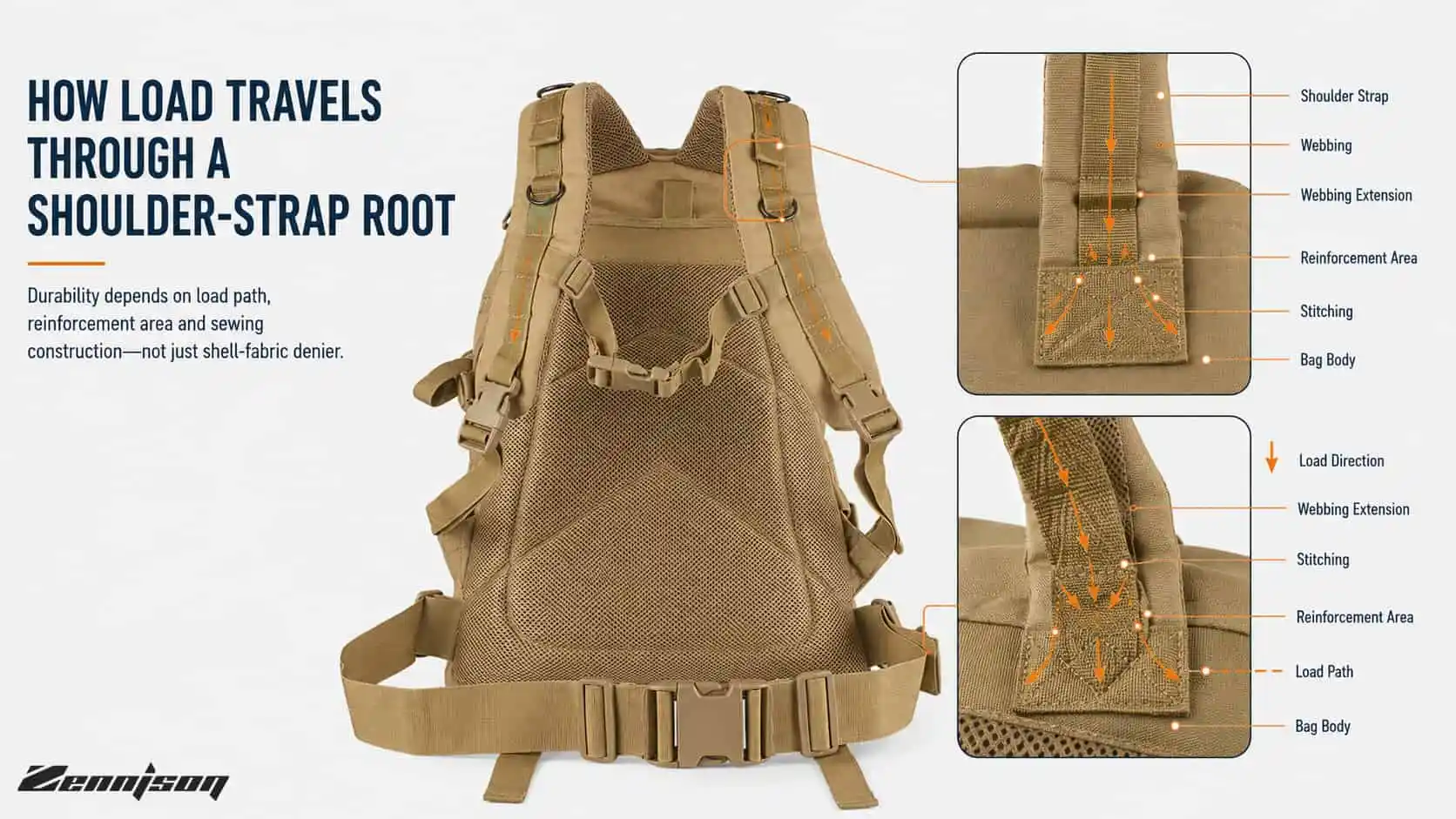
Changing a panel from 500D to 1000D does not, by itself, define the durability of a shoulder-strap root. If the webbing ends too close to the attachment point or the reinforcement area is too limited, the load remains concentrated.
Military-style shoulder systems make this relationship especially clear. The design can include sandwich mesh or foam, full-length webbing reinforcement, adjustable or removable straps, quick-release hardware, hydration-tube routing, attachment points and a chest strap.
Each element affects the others. A hardware change can alter the webbing layout, sewing access, reinforcement and the way force reaches the bag body.
The shell fabric remains part of the specification. The load path tells us whether the structure works.
7. How We Validate the Material System During Sampling
A material list remains theoretical until the components are assembled into a physical product.
Sampling shows what individual swatches cannot: stiffness around an opening, buildup at a bound seam, interaction between shell and foam, hardware movement, overall structure and the relationship between the shoulder system and the bag body.
During sampling, we bring each material choice back to the product requirement:
- Does the shell create the intended structure?
- Do the layers introduce unnecessary stiffness?
- Are openings, gussets and adjustment points practical?
- Are layered areas workable for sewing and assembly?
- Does the shoulder system transfer load into the pack body as intended?
- Is the water-resistance construction applied where it is needed?
- Does the complete pack remain aligned with its positioning and cost target?
Sampling is also where material location becomes specific. “500D nylon” is not enough. The sample and BOM need to show which panels use it, where other materials take over and how those transitions are constructed.
When the buyer specifies a branded material, a measurable water-resistance requirement or another technical result, the evaluation criteria need to be defined before approval. A visual sample approval is not the same as technical performance confirmation.
8. What Buyers Should Define in the RFQ, BOM and Approved Sample
A useful backpack specification develops in three stages: the RFQ defines the requirement, the BOM defines the materials, and the approved sample shows how the system is assembled.
In the RFQ
The most important inputs are:
- product positioning and use environment;
- pack size and expected load;
- water-resistance requirement;
- cost target;
- required material brand, testing or documentation.
The RFQ does not need to solve every construction detail. It needs to give us enough context to recommend a relevant material direction.
In the BOM
The BOM needs to identify:
- material and product location;
- fiber, denier and construction;
- coating, backing or treatment;
- color and material reference;
- key lining, webbing, reinforcement, support and hardware requirements.
If genuine CORDURA® is required, the exact branded material belongs in the BOM. It should not be assumed from “500D” or “1000D.”
In the approved sample
The sample confirms the physical relationship between materials:
- where each material is used;
- how reinforcement is shaped and layered;
- how webbing extends into the structure;
- how the shoulder and support systems are built;
- how key seams, bindings and transitions are finished.
The BOM identifies the components. The approved sample shows how they work together.
If a buyer sends us only “500D” or “1000D,” that is usually the beginning of the material discussion—not the end of it.
Send us the intended use, pack size, expected load, water-resistance requirement and target positioning. From there, we can develop a material proposal, map each component to its job and use the sampling stage to refine the complete OEM backpack specification.