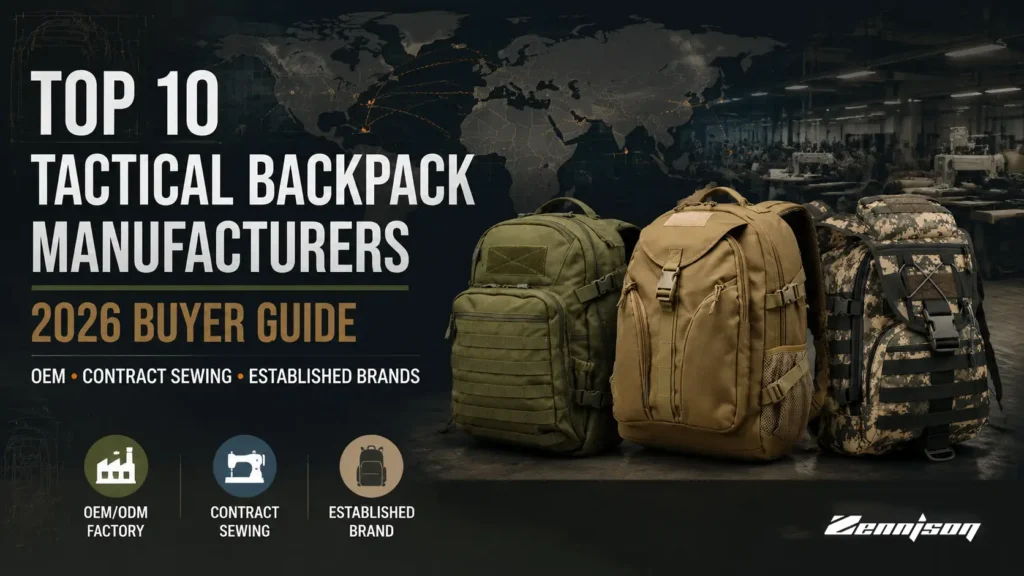
Tactical backpacks may look similar in product photos, but for bulk buyers they are highly specification-driven products. Capacity, fabric, MOLLE webbing, compartment layout, hydration compatibility, zipper quality, buckle strength, carrying comfort and OEM packaging can all change the final cost and user experience.
For importers, tactical gear brands, outdoor distributors, government suppliers and private label buyers, the key question is not only which backpack looks tactical. The more useful question is: which tactical backpack specification fits the intended load, market price point, end-use scenario and bulk order requirements?
This guide explains how to compare tactical backpacks before placing a wholesale or OEM order. If you are already preparing a sourcing project, Zennison’s tactical backpack manufacturer page gives a direct overview of available bulk supply and customization options.
Quick Answer: What Should Bulk Buyers Check First?
For most tactical backpack orders, buyers should confirm six specifications first: capacity, fabric, MOLLE system, compartment layout, carrying system and OEM packing. These details decide whether the product is suitable for tactical retail, patrol use, hiking, emergency kits, military-style procurement or large-capacity expedition supply.
A practical baseline specification is:
- Capacity: 25-35L for compact tactical packs, 45L for daily or short-mission use, 70-90L for large load-bearing systems.
- Fabric: 600D Oxford, 900D fabric, 1000D nylon or custom fabric depending on durability and price target.
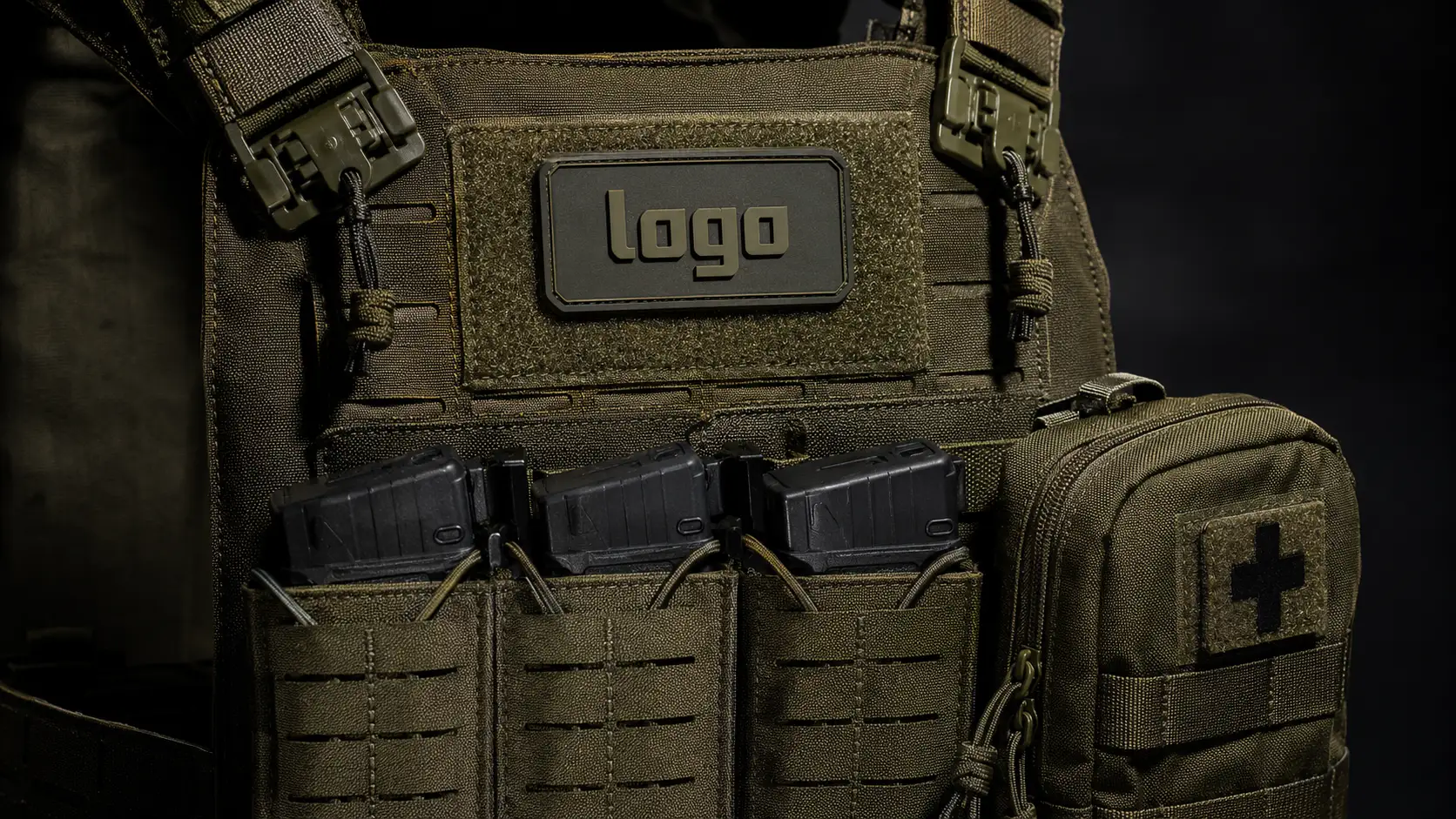
- MOLLE: front and side webbing with consistent spacing for pouches and accessories.
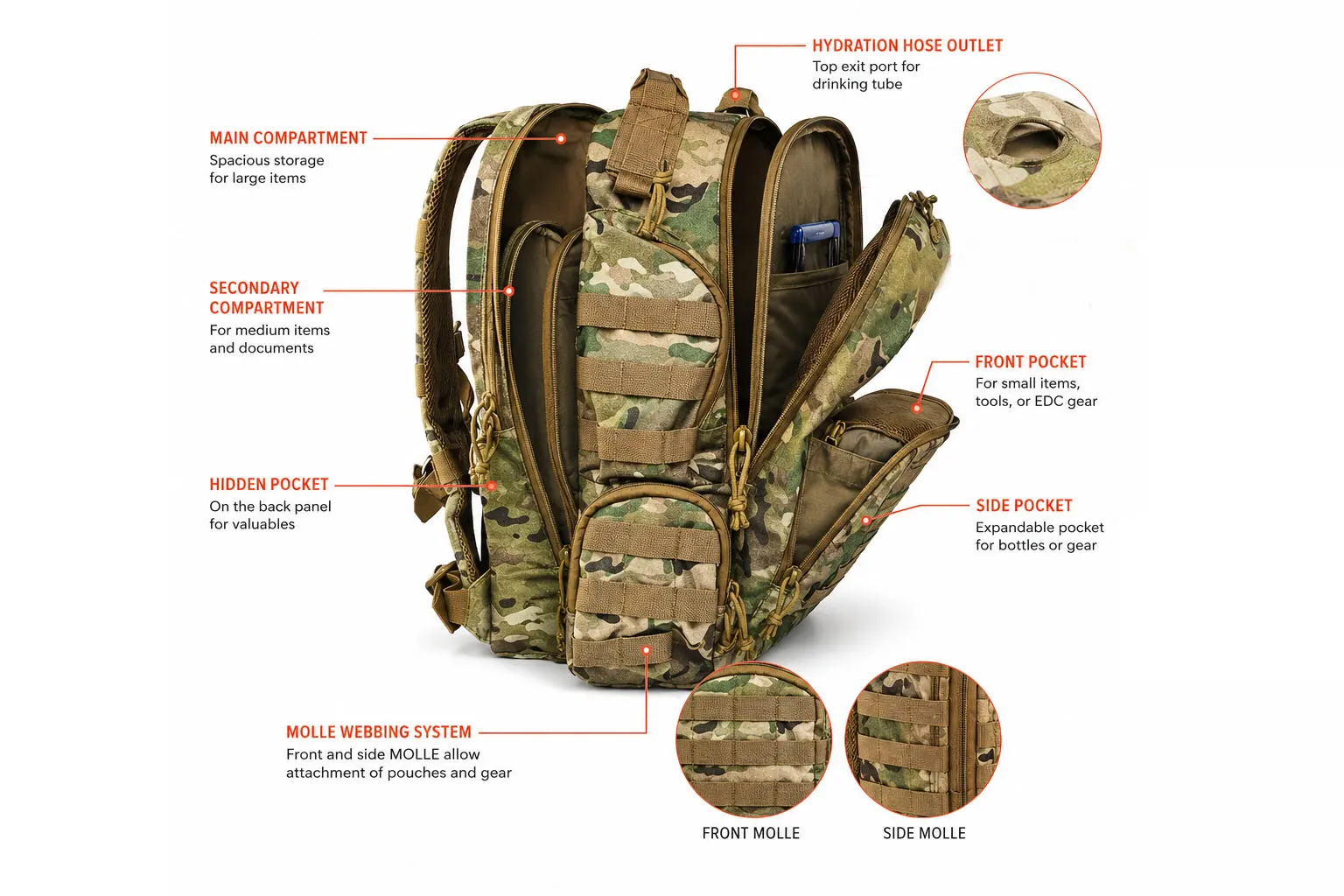
- Compartments: main compartment, secondary compartment, front utility pocket, side pockets, hidden pocket and hydration bladder pocket.
- Carrying system: padded shoulder straps, chest strap, waist belt, breathable back panel and reinforced handle.
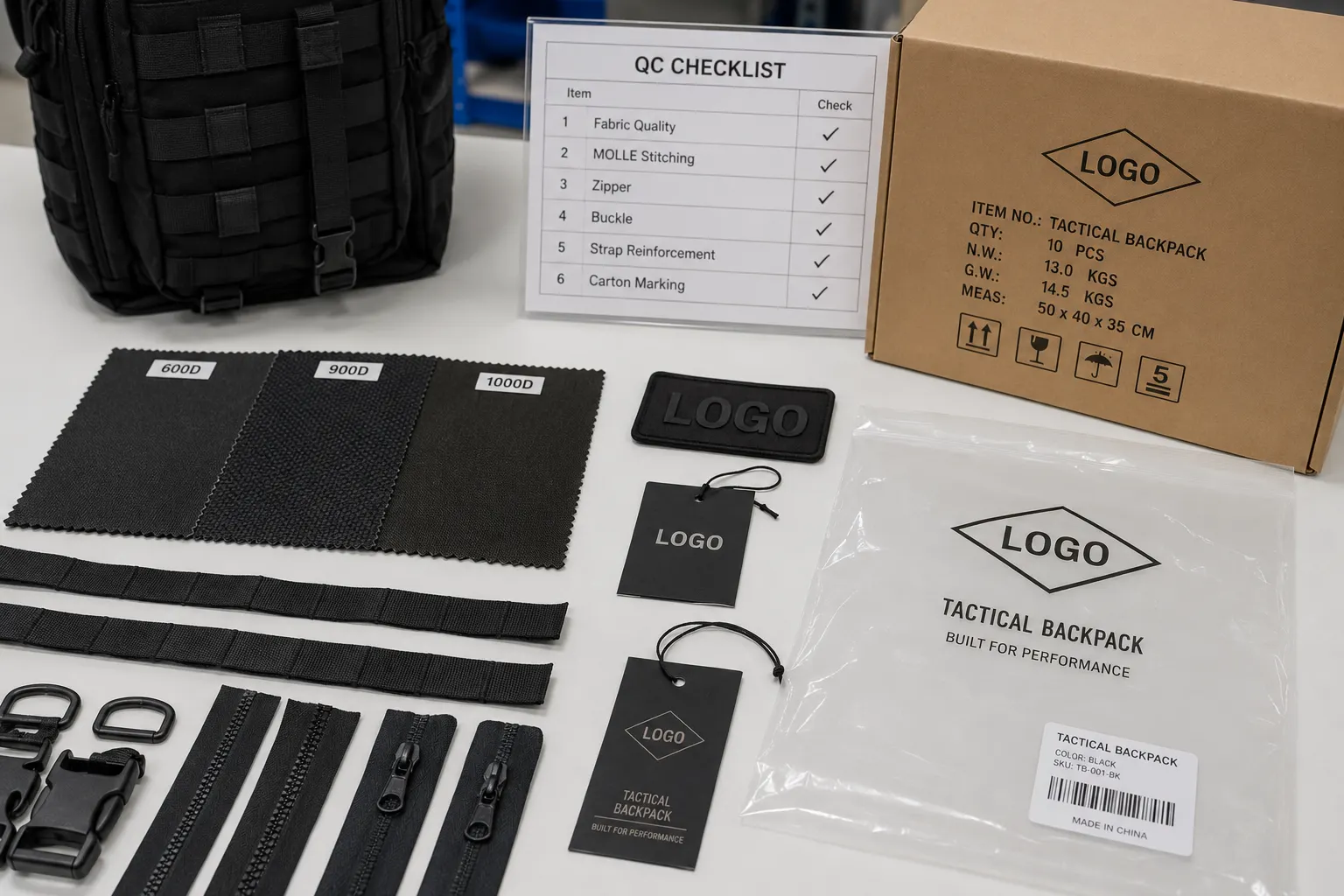
- OEM: custom color, logo, patch area, zipper puller, woven label, hangtag, polybag and carton marking.
1. Tactical Backpacks Are Specification-Driven Products
A tactical backpack is not defined by camouflage color alone. In B2B procurement, the value comes from structure, fabric strength, storage logic, load-bearing comfort and modular compatibility.
A common sourcing mistake is to approve a backpack based only on front-view photos. Two backpacks may look similar online, but one may use thinner fabric, weaker webbing, low-grade buckles, rough zipper movement or a poor back panel. These differences usually appear after sampling, field use or customer complaints.
For bulk orders, the backpack should be defined as a system:
- Load capacity and finished dimensions.
- Main fabric, lining fabric and reinforcement material.
- Compartment structure and pocket arrangement.
- MOLLE webbing and external attachment layout.
- Shoulder strap, chest strap, waist belt and back panel design.
- Zipper, buckle, D-ring, hook-and-loop and sewing quality.
- Logo method, label, color, packing and carton requirements.
2. Main Tactical Backpack Types for Bulk Buyers
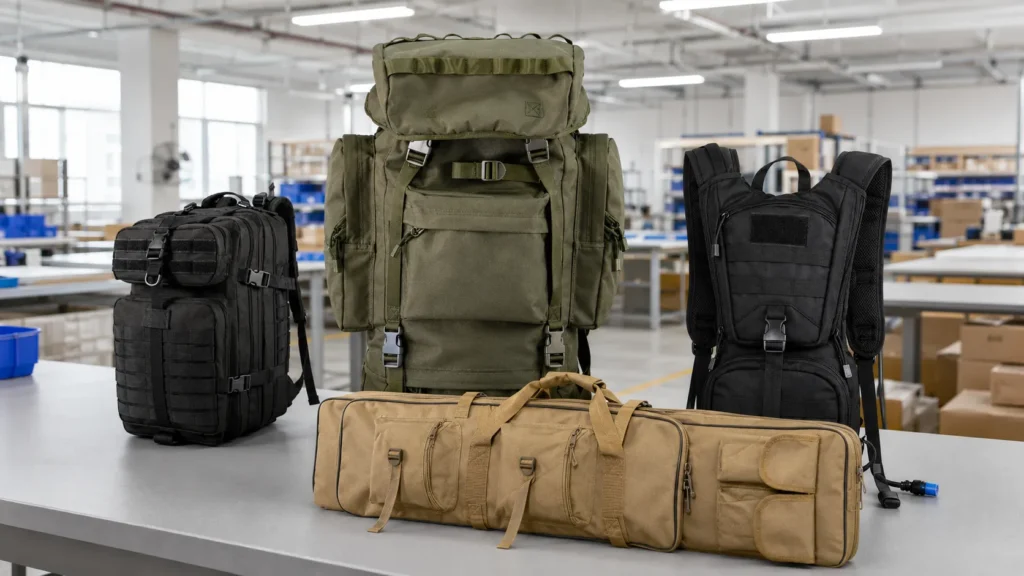
The right tactical backpack type depends on the buyer’s sales channel and use scenario. A 28L 3P pack, a 70L ALICE-style pack and a rifle bag solve different procurement problems.
| Product type | Common capacity or size | Best use case | Buyer notes |
|---|---|---|---|
| 3P tactical backpack | Around 25-35L | Outdoor retail, travel, patrol, daily tactical carry | Good balance of storage, price and retail appeal |
| Multi-compartment assault pack | Around 35-45L | Short missions, camping kits, tactical catalog programs | Compartment logic, MOLLE layout and zipper quality matter |
| ALICE-style load-bearing pack | Around 70-80L | Military-style load carriage and larger outdoor supply | Frame compatibility, fabric strength and shoulder comfort need review |
| Large military backpack | Around 80-90L | Longer outdoor trips, survival kits, field supply | Load support and waist belt quality become critical |
| Hydration backpack | Compact or medium capacity | Training, cycling, hiking, tactical hydration kits | Bladder pocket, hose outlet and back comfort should be checked |
| Tactical gun bag or rifle bag | 85 x 30cm, 100 x 30cm, 120 x 30cm or custom | Outdoor clubs, range use, tactical gear distributors | Size, padding, internal fixation and legal market requirements matter |
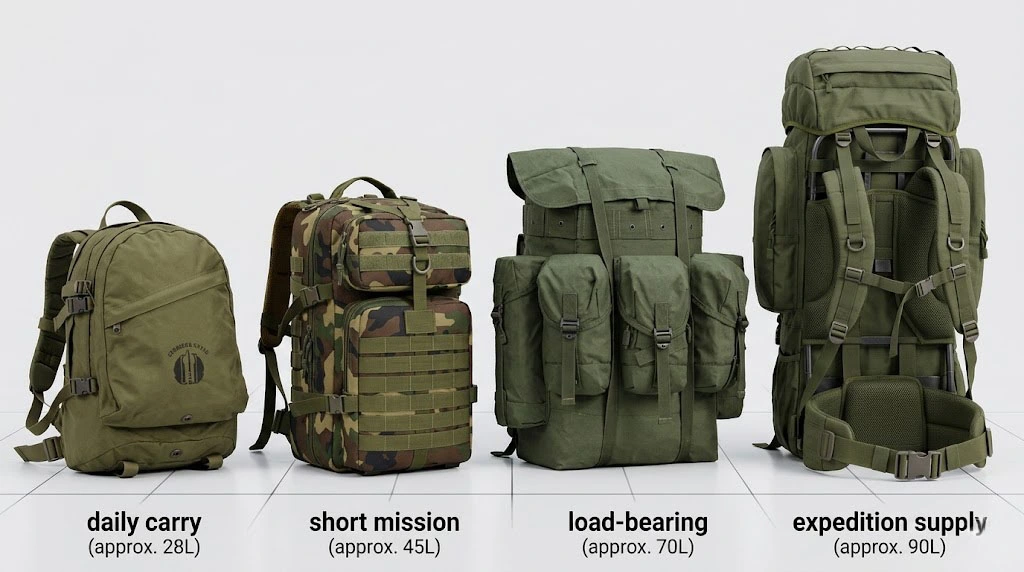
3. Capacity: 28L, 45L, 70L or 90L?
Capacity is one of the first specifications buyers should define. A small tactical day pack and a large load-bearing backpack should not be compared by unit price alone.
Common capacity directions include:
- 25-35L: suitable for daily tactical carry, patrol, travel, hiking and general outdoor retail.
- 35-45L: useful for short missions, overnight packing, camping kits and tactical distributors that need a more complete pack.
- 70-80L: suitable for ALICE-style or larger military load-bearing systems.
- 80-90L: suitable for long outdoor use, large gear loads and field supply programs.
- Rifle bag sizes: common length options may include 85cm, 100cm and 120cm depending on product design and target market.
For bulk procurement, ask whether the quoted capacity is based on the main compartment only or the total backpack volume including secondary compartments and pockets. This avoids confusion when comparing offers from different suppliers.
4. Fabric Choice: 600D Oxford, 1000D Nylon or Custom Material?
Fabric is one of the largest cost and durability drivers. A backpack made from 600D Oxford and one made from 1000D nylon can target very different markets even if the design looks similar.
Common fabric options include:
- 600D Oxford: cost-effective and common for tactical retail, promotional outdoor programs and general-use backpacks.
- 900D or higher-density polyester: useful when buyers want stronger appearance and better abrasion resistance without moving fully into premium nylon.
- 1000D nylon: often used for higher durability, ALICE-style packs, load-bearing systems and more demanding tactical positioning.
- Water-resistant coated fabric: useful for outdoor and emergency use, but coating quality should be checked.
- Camouflage or custom color fabric: suitable for tactical catalog, hunting, military-style and private label programs.
Do not compare fabric only by denier number. Buyers should also check fabric handfeel, coating, color fastness, tear resistance, abrasion resistance, lining material and reinforcement panels at stress points.
5. MOLLE Webbing and External Attachment System
MOLLE webbing is one of the most important tactical backpack features. It allows users to attach pouches, tools, bottle holders, medical kits or other modular accessories.
For bulk orders, MOLLE should be checked carefully:
- Webbing spacing should be consistent.
- Stitching should be straight and reinforced.
- Webbing width and fabric should match the intended load.
- Front and side MOLLE layout should support common pouches.
- Hook-and-loop patch panels should be sized correctly for badges or logo patches.
- External straps should not block pocket opening or zipper movement.
A backpack can look tactical with webbing, but poor MOLLE alignment can reduce practical value. For tactical brands and distributors, modular compatibility should be checked on the sample, not assumed from a photo.
6. Compartment and Pocket Layout
Compartment layout affects how useful the backpack feels in real use. Buyers should define storage logic before asking for a final quotation.
A practical tactical backpack may include:
- Main compartment: the largest storage area, usually closest to the back.
- Secondary compartment: smaller front storage for organized gear.
- Front pocket or utility pocket: quick access for gloves, documents, tools or emergency items.
- Side pockets: useful for bottles, small tools or compact outdoor accessories.
- Top pocket or lid pocket: common on larger rucksack-style designs.
- Hidden pocket or back pocket: useful for valuables, documents or flat items.
- Hydration bladder pocket: used for water bladder storage and hose routing.
For B2B buyers, the goal is not to add as many pockets as possible. The goal is to make the backpack easy to pack, easy to access and suitable for the buyer’s customer group.
7. Carrying Comfort: Shoulder Straps, Back Panel and Waist Belt
Carrying comfort becomes more important as capacity increases. A small 28L backpack may only need padded shoulder straps and a breathable back panel, while a 70L or 90L backpack needs stronger load support.
Key carrying system points include:
- Shoulder strap width, thickness and padding density.
- Breathable mesh or padded back panel.
- Chest strap for load stabilization.
- Waist belt or hip belt for larger backpacks.
- Load adjustment straps on larger packs.
- Reinforced top handle and side handles where needed.
- Back panel structure for ventilation and comfort.
If the backpack is designed for heavy loads, buyers should test strap strength and load comfort. A strong fabric body is not enough if the shoulder straps, buckles or waist belt fail under weight.
8. Hydration Bladder Compatibility
Hydration compatibility is common in tactical and outdoor backpacks. A hydration-ready backpack should not only have an internal pocket. It should also have practical hose routing and enough space for the bladder.
Buyers should confirm:
- Hydration bladder pocket size.
- Hose outlet location.
- Internal hanging loop or fixing point.
- Compatibility with common bladder capacities.
- Whether the hydration pocket affects main compartment storage.
- Whether the hose outlet is cleanly finished and reinforced.
For training, hiking, cycling and tactical field-use products, hydration compatibility can raise product value. For budget or simple retail programs, it may be optional.
9. OEM Tactical Backpack Specification Checklist
Before asking for a quotation, prepare a clear specification sheet. This helps the manufacturer quote accurately and reduces misunderstandings.
OEM Tactical Backpack Specification Checklist
Use this checklist before requesting samples or bulk pricing:
- Product type: 3P backpack, assault pack, hydration pack, ALICE-style pack, large military backpack, gun bag or custom design.
- Capacity: 28L, 35L, 45L, 70L, 80-90L or custom capacity.
- Dimensions: height, width, depth and allowable tolerance.
- Main fabric: 600D Oxford, 900D fabric, 1000D nylon, camouflage fabric or custom material.
- Lining fabric: polyester lining, nylon lining or custom lining.
- MOLLE layout: front, side, bottom, shoulder strap or custom positions.
- Compartments: main compartment, secondary compartment, front pocket, side pocket, hidden pocket and hydration pocket.
- Carrying system: shoulder straps, chest strap, waist belt, back panel, frame or load support.
- Hardware: zipper, buckle, D-ring, hook-and-loop, puller and webbing type.
- Color: black, olive green, coyote brown, khaki, gray, camouflage or custom Pantone color.
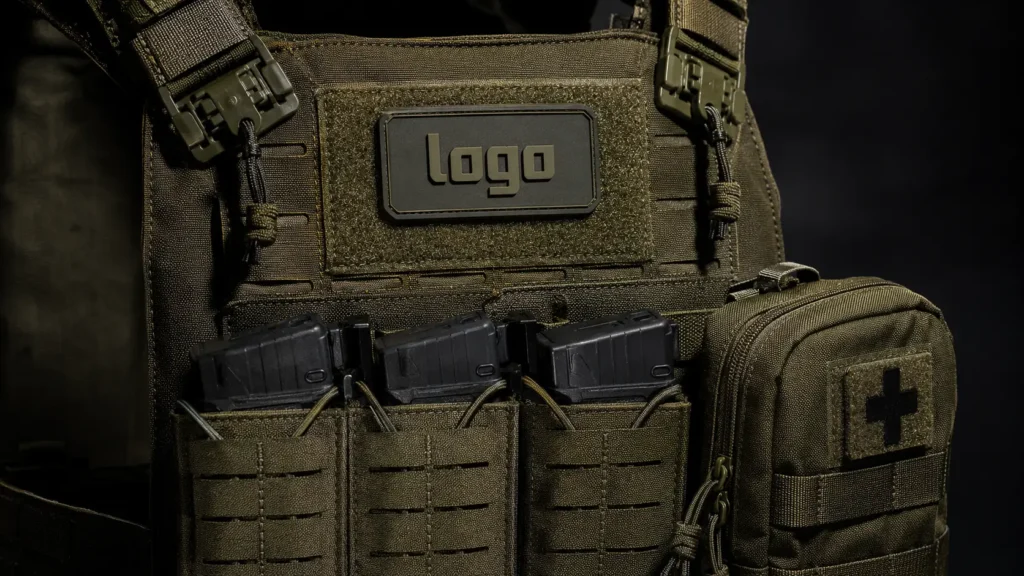
- Logo method: woven label, rubber patch, embroidery, screen print, hook-and-loop patch or custom logo panel.
- Packing: polybag, hangtag, barcode label, master carton, carton marking and private label packaging.
A clear specification makes quotation comparison much easier. Without these details, a lower price may simply mean thinner fabric, lower-grade zippers, weaker webbing, simpler padding or reduced packing quality.
10. Logo, Color and Private Label Options
OEM tactical backpack programs can be customized in several ways. The correct method depends on the product positioning, order quantity and sales channel.
Common customization options include:
- Custom fabric color or camouflage pattern.
- Woven label or rubber logo patch.
- Embroidery or screen printed logo.
- Hook-and-loop patch area for removable badges.
- Custom zipper puller or webbing color.
- Hangtag, barcode label, insert card and private label polybag.
- Carton marking and export packing based on distribution needs.
For tactical brands, logo placement should not interfere with MOLLE use, zipper movement or pocket access. For promotional programs, visibility may be more important than field function.
11. Quality Control Points for Bulk Orders
For tactical backpacks, QC should focus on structure, strength, appearance and packing consistency. A backpack has many stress points, so inspection should go beyond a simple visual check.
Recommended QC checks include:
- Finished dimensions and capacity comparison against approved sample.
- Fabric defects, coating consistency, color difference and stains.
- MOLLE webbing spacing, stitching and alignment.
- Zipper smoothness, zipper strength and puller quality.
- Buckle, D-ring and hook-and-loop strength.
- Shoulder strap, chest strap and waist belt sewing strength.
- Back panel padding and mesh quality.
- Compartment layout and pocket opening function.
- Hydration bladder pocket and hose outlet finishing.
- Logo placement, label content and packaging accuracy.
- Carton quantity, carton strength and shipping mark confirmation.
For large-capacity backpacks or gun bags, buyers should also check load-bearing points, padding thickness, internal fixation, handle strength and carton protection.
12. Common Buying Mistakes
The most common mistake is comparing tactical backpack prices without comparing specifications. A 28L 600D day pack, a 45L assault pack, a 90L military rucksack and a rifle bag are not the same product.
Other common mistakes include:
- Approving a backpack only from front-view photos.
- Ignoring fabric density, coating and reinforcement points.
- Assuming all MOLLE webbing is compatible and evenly spaced.
- Not checking shoulder strap and waist belt strength for heavy-load packs.
- Forgetting hydration bladder pocket and hose outlet details.
- Adding logo and private label packaging after the price has already been confirmed.
- Comparing rifle bag prices without confirming size, padding and internal fixation.
- Not approving a pre-production sample before mass production.
For B2B buyers, the goal is not simply to choose the lowest unit price. The goal is to choose a backpack specification that matches expected load, customer use, retail price and repeat-order potential.
13. Which Tactical Backpack Specification Should You Choose?
If you need a practical mass-market option, start with a 25-35L tactical backpack using 600D Oxford fabric, MOLLE webbing, multiple compartments, padded shoulder straps and basic private label packing.
If you need a more tactical or outdoor-focused product, consider stronger fabric, reinforced stitching, better zippers, hydration compatibility, improved back panel comfort and more carefully planned MOLLE layout.
If you need a large load-bearing backpack, focus on frame compatibility, waist belt quality, shoulder strap strength, 1000D-style fabric options and carton protection.
If you need a tactical gun bag or rifle bag, confirm finished length, internal padding, fixation straps, carrying handles, shoulder strap structure and market-specific requirements before ordering.
Conclusion
Tactical backpacks are not one-size-fits-all products. For bulk procurement, the best choice depends on the complete specification: capacity, fabric, MOLLE webbing, compartment layout, hydration compatibility, carrying comfort, hardware, color, logo and packing.
A good supplier should help buyers compare these details clearly instead of only sending product photos and unit prices. If you are preparing a wholesale or OEM backpack project, define your capacity, fabric, structure, logo, packing and QC requirements before requesting a quote.
Zennison supplies tactical backpacks, military backpacks, hydration packs, large outdoor packs, tactical gun bags and OEM private label options for bulk buyers. Visit our tactical backpack manufacturer page to explore available options or request a customized quotation.
FAQ
What capacity is best for tactical backpacks?
The best capacity depends on the use scenario. A 25-35L backpack is suitable for daily carry, patrol and general outdoor retail. A 35-45L pack works better for short missions and larger gear loads. A 70-90L pack is more suitable for large military-style load-bearing or expedition use.
What fabric is commonly used for tactical backpacks?
Common fabric options include 600D Oxford, higher-density polyester, 1000D nylon and camouflage fabric. 600D fabric is cost effective for general tactical retail, while 1000D nylon or stronger materials are better for heavy-load or premium tactical programs.
What is MOLLE on a tactical backpack?
MOLLE is a modular webbing system that allows users to attach pouches, tools, bottle holders, medical kits and other accessories. For bulk orders, buyers should check webbing spacing, stitching, placement and compatibility with common tactical pouches.
Can tactical backpacks be customized with logo and colors?
Yes. Customization options can include fabric color, camouflage pattern, woven label, rubber patch, embroidery, screen print, hook-and-loop patch area, custom zipper puller, hangtag, polybag and private label carton marking.
What should buyers confirm before bulk production?
Buyers should confirm capacity, dimensions, fabric, lining, MOLLE layout, compartment structure, zipper and buckle quality, carrying system, logo method, packing method and QC requirements. A pre-production sample should be approved before mass production.
Does Zennison supply tactical gun bags and large military backpacks?
Yes. Zennison can supply tactical backpacks, large military-style backpacks, hydration packs and tactical gun bags for bulk and OEM projects. Buyers should confirm size, fabric, padding, internal fixation, logo, packing and market requirements before ordering.