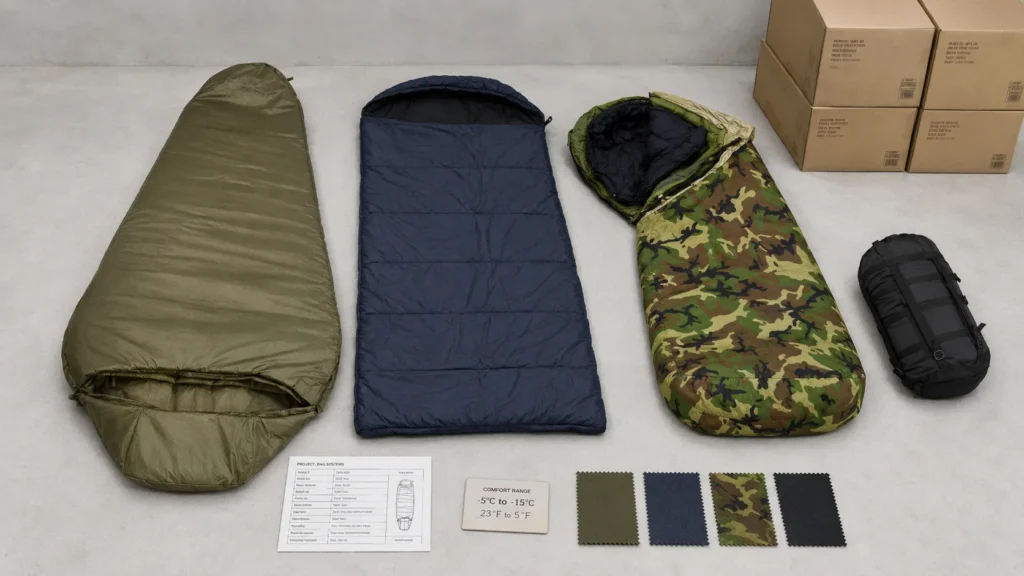
Military sleeping bags may look like simple outdoor products, but for bulk buyers they are specification-heavy items. Temperature rating, filling type, shell fabric, lining, shape, zipper structure, compression packing and carton protection can all change the final cost, field performance and complaint rate.
For importers, outdoor brands, government suppliers, emergency kit distributors and tactical gear companies, the key question is not only which sleeping bag looks military. The more useful question is: which sleeping bag specification fits the expected climate, user group, retail price point and bulk order requirements?
This guide explains how to compare military sleeping bags before placing a wholesale or OEM order. If you are already preparing a sourcing project, Zennison’s wholesale military sleeping bags page gives a direct overview of available bulk and customization options.
Quick Answer: What Should Bulk Buyers Check First?
For most military sleeping bag orders, buyers should confirm six specifications first: temperature rating, filling type, shell fabric, lining fabric, sleeping bag shape and packing method. These details decide whether the product is suitable for army training, outdoor retail, camping kits, emergency supply, patrol use or cold-weather field deployment.
A practical baseline specification is:
- Temperature rating: define comfort, limit or target use temperature clearly.
- Filling: synthetic hollow fiber or other insulation based on cost, warmth and drying needs.
- Shell fabric: polyester, nylon, ripstop or water-resistant fabric depending on positioning.
- Lining: soft polyester, pongee, taffeta or cotton-blend lining depending on comfort needs.
- Shape: mummy, envelope, patrol-style, modular system or custom military design.
- Packing: compression sack, carry bag, individual polybag, carton and private label packing.
1. What Makes Military Sleeping Bags Different?
A military sleeping bag is usually designed for more demanding field use than a basic leisure camping bag. It may need a more compact packed size, stronger fabric, darker or camouflage color, better zipper protection, reliable insulation and easier storage in a rucksack or vehicle kit.
In B2B procurement, military sleeping bags are often used for:
- Military and police training supply.
- Outdoor retail and tactical gear catalogs.
- Emergency rescue and disaster preparedness kits.
- Camping, hunting and survival product lines.
- Government-style procurement or institutional supply.
- Private label outdoor equipment programs.
This matters because the same product photo can hide very different specifications. A sleeping bag with thin filling and weak fabric may be acceptable for warm-weather promotional use, but it may not be suitable for a tactical brand or cold-weather government supply program.
2. Temperature Rating: The First Specification to Clarify
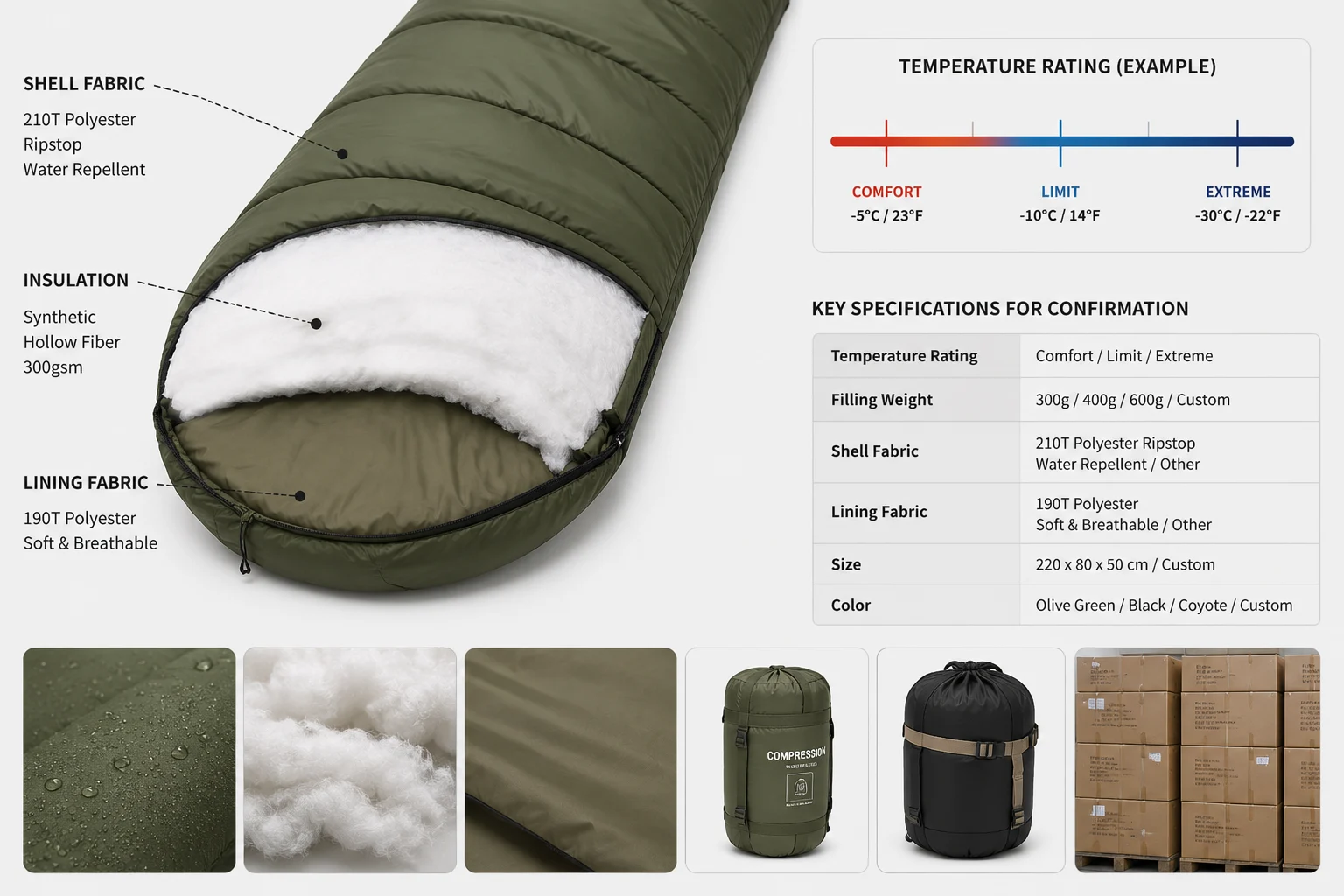
Temperature rating is one of the most important specifications for military sleeping bags, but it is also one of the most commonly misunderstood. Buyers should ask how the rating is defined and what use condition it is meant to represent.
Many suppliers and markets use terms such as comfort temperature, limit temperature or extreme temperature. These terms should not be treated as the same number.
| Temperature term | What it usually means | Buyer notes |
|---|---|---|
| Comfort temperature | The range where a normal user is expected to sleep more comfortably | Most useful for retail claims and buyer expectation management |
| Limit temperature | The lower range where a trained or prepared user may still use the bag | Should be explained carefully to avoid overpromising warmth |
| Extreme temperature | A survival-oriented reference, not a comfort claim | Should not be used as the main selling promise for normal sleep comfort |
| Season rating | General seasonal use, such as summer, 3-season or winter | Easy for retail communication, but less precise for procurement |
For bulk orders, ask the supplier to confirm the target use environment. A sleeping bag for summer training, a 3-season outdoor catalog and a cold-weather military kit should not use the same filling weight or fabric structure.
3. Filling Options: Synthetic Insulation, Hollow Fiber or Down?
Filling is the main driver of warmth, weight, packed size and cost. For military-style and bulk outdoor orders, synthetic insulation is commonly used because it is cost efficient, easier to maintain and more stable in humid or rough field conditions.
Common filling directions include:
- Hollow fiber: widely used for cost-effective bulk sleeping bags. It offers practical warmth, simple maintenance and predictable pricing.
- Polyester synthetic insulation: suitable for tactical, camping and emergency supply projects where durability and moisture resistance are important.
- Down filling: lighter and more compressible, but usually higher cost and more sensitive to moisture, care requirements and sourcing documentation.
- Layered synthetic filling: useful when buyers need better loft distribution or a more stable warmth structure.
For most wholesale military sleeping bags, the buyer should not only ask for the filling name. Confirm filling weight, total bag weight, loft, packed size and whether the filling is evenly distributed after compression.
4. Shell Fabric and Lining: Durability vs Comfort
The shell fabric protects the sleeping bag from abrasion, moisture and repeated packing. The lining affects user comfort during sleep. Both should be specified clearly before quotation.
Common shell fabric options include:
- Polyester taffeta for cost-effective outdoor and camping programs.
- Nylon fabric for lighter or higher-positioned products.
- Ripstop fabric for stronger field-use positioning.
- Water-resistant coated fabric for better outdoor practicality.
- Camouflage or solid tactical colors for military-style catalogs.
Common lining options include:
- Polyester pongee for a softer handfeel.
- Polyester taffeta for lightweight and cost control.
- Brushed or warm-touch lining for comfort-focused cold-weather products.
- Cotton-blend lining for selected comfort programs, usually with higher weight.
For B2B buyers, fabric selection should match the sales channel. A rugged tactical catalog may need stronger shell fabric and darker colors. A budget camping promotion may need a lower-cost shell and simpler packing. A cold-weather product line may need better lining comfort and more insulation.
5. Main Types of Military Sleeping Bags
The right sleeping bag type depends on the end-use scenario. A compact patrol sleeping bag, a roomy envelope bag and a modular military sleep system solve different problems.
| Sleeping bag type | Common features | Best use case | Buyer notes |
|---|---|---|---|
| Mummy sleeping bag | Tapered shape, hood, closer fit | Cold-weather, backpacking, tactical field use | Better thermal efficiency, but less roomy than envelope bags |
| Envelope sleeping bag | Rectangular shape, more space, simple construction | Camping, emergency kits, entry-level outdoor retail | Comfortable and cost friendly, but less efficient in cold conditions |
| Patrol sleeping bag | Lightweight, compact, often used in mild conditions | Training, patrol, warm-weather field supply | Good for mobility and packing, not ideal for severe cold alone |
| Modular sleeping system | Multiple layers, optional bivy cover, compression sack | Military-style cold-weather or multi-season supply | Higher value and flexibility, but more complex to specify and pack |
| Camouflage sleeping bag | Camo shell, tactical color, outdoor field appearance | Military surplus, hunting, tactical retail | Pattern, color consistency and fabric durability affect perceived value |
6. Mummy vs Envelope Sleeping Bags: Which One Should Buyers Choose?
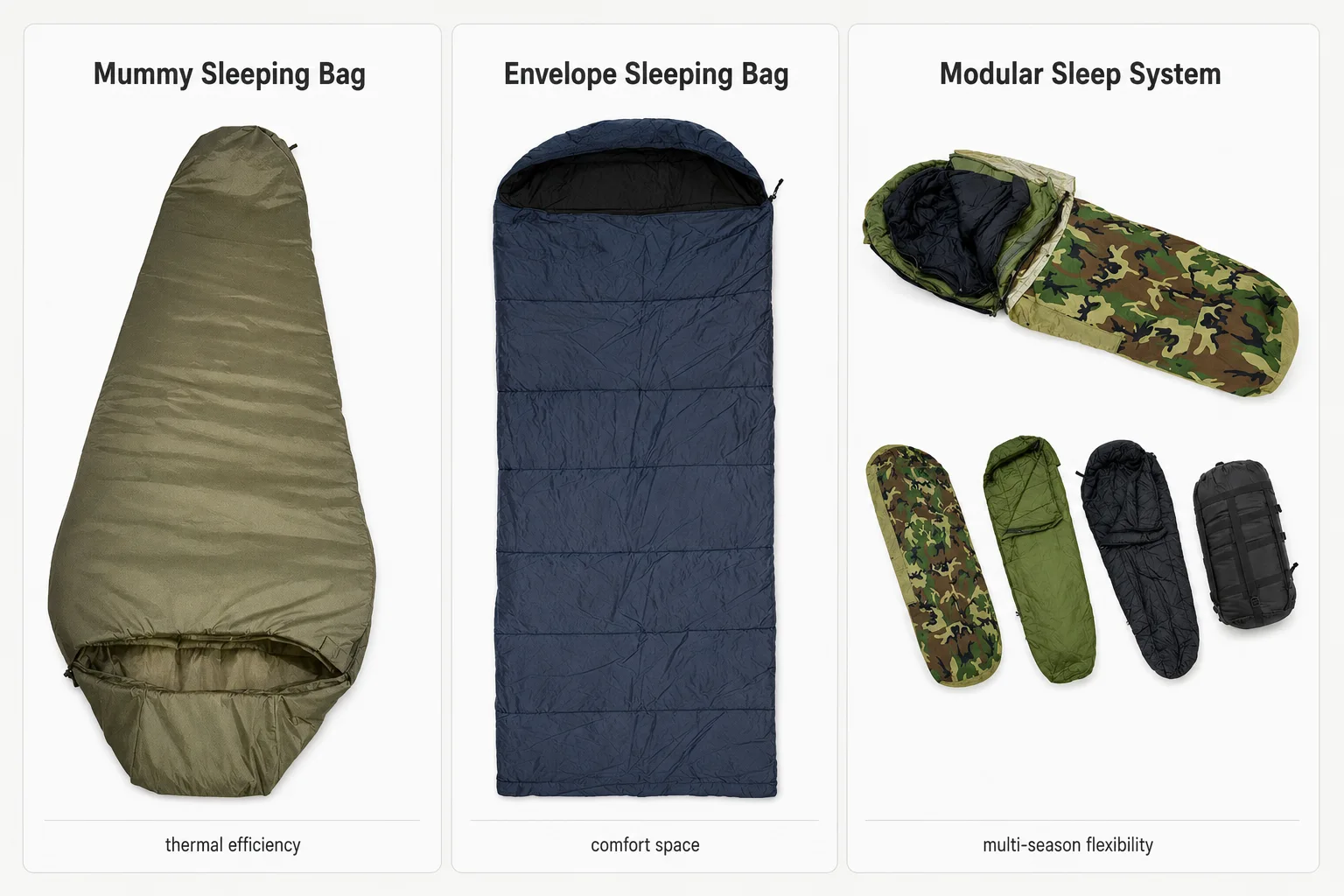
A mummy sleeping bag is usually better for thermal efficiency because the tapered shape reduces empty space inside the bag. It is useful for colder environments, backpacking-style products and military-style field gear.
An envelope sleeping bag is usually easier to use and more comfortable for casual users because it offers more internal space. It can also be opened flat in some designs, making it suitable for camping, emergency kits and budget outdoor retail programs.
For bulk buyers, the decision should be based on target customer expectations:
- Choose mummy shape when warmth, packed size and tactical positioning matter most.
- Choose envelope shape when comfort, lower cost and general camping use matter most.
- Choose modular systems when the buyer needs multi-season flexibility and higher product value.
7. Compression Sack and Packing: More Important Than Many Buyers Expect
Packing affects shipping cost, warehouse handling, retail presentation and user experience. A military sleeping bag is often expected to pack down into a compact compression sack for field carry.
Common packing options include:
- Standard carry bag.
- Compression sack with straps.
- Water-resistant stuff sack.
- Individual polybag.
- Private label carry bag.
- Color box or retail carton for selected programs.
- Master carton with shipping marks and barcode labels.
For export orders, confirm the packed size and carton quantity before approving the price. A sleeping bag that compresses poorly can increase shipping volume and reduce the attractiveness of the product for retail or field use.
8. How to Build a Clear OEM Sleeping Bag Specification
Before asking for a quotation, prepare a specification sheet. This helps the supplier quote accurately and makes it easier to compare different offers.
OEM Sleeping Bag Manufacturer Specification Checklist
Use this OEM sleeping bag checklist before asking for a quotation:
- Product type: mummy, envelope, patrol, modular system, camouflage bag or custom design.
- Temperature target: comfort temperature, limit temperature, season rating or target climate.
- Outer shell fabric: polyester, nylon, ripstop, water-resistant fabric, camouflage fabric or custom.
- Lining fabric: polyester pongee, taffeta, brushed lining, cotton blend or custom.
- Filling type: hollow fiber, polyester synthetic insulation, down or other requested material.
- Filling weight: grams per square meter, total filling weight or target total bag weight.
- Size: length, shoulder width, foot width and packed size.
- Color: olive green, black, coyote, khaki, camouflage or custom Pantone color.
- Zipper: side, two-way, anti-snag, left/right compatibility or custom puller.
- Accessories: hood, draft collar, draft tube, footbox, inner pocket or hanging loops.
- Packing: compression sack, carry bag, polybag, retail box, carton quantity and shipping marks.
- Branding: woven label, printed logo, hangtag, packaging card or private label carton marking.
The more specific this list is, the easier it is to avoid quotation confusion. Without these details, a lower price may simply mean thinner filling, weaker shell fabric, simpler lining or cheaper packing.
9. Quality Control Points for Bulk Military Sleeping Bags
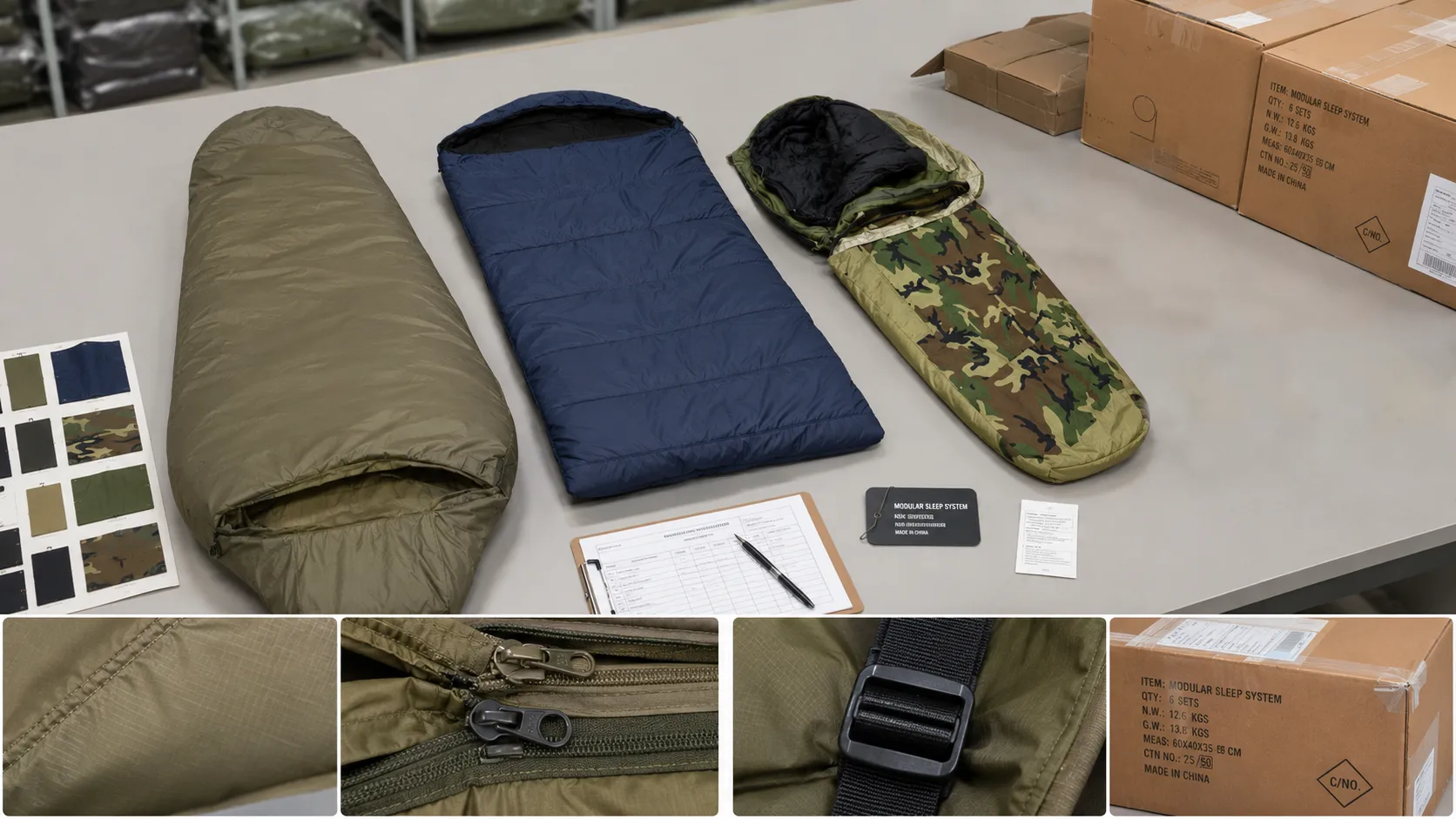
For bulk sleeping bag orders, QC should focus on warmth-related structure, fabric durability, sewing quality, packing and consistency against the approved sample.
Recommended QC checks include:
- Finished size measurement.
- Total weight and filling weight comparison.
- Filling distribution and loft consistency.
- Shell fabric defects, stains, holes or coating problems.
- Lining comfort and fabric cleanliness.
- Zipper smoothness, zipper strength and anti-snag performance.
- Stitching strength at stress points.
- Hood, drawcord, draft tube and footbox construction.
- Compression sack stitching and strap strength.
- Logo placement, label content and hangtag accuracy.
- Packed size, carton quantity and carton compression protection.
For private label or government-style supply projects, also confirm whether your market needs material documentation, labeling requirements, flammability-related testing, care instructions or specific carton labeling.
10. Common Buying Mistakes
The most common mistake is comparing sleeping bag prices without comparing specifications. A summer envelope sleeping bag, a mummy tactical sleeping bag and a modular military sleep system are not the same product.
Other common mistakes include:
- Using the lowest temperature number as a comfort claim.
- Comparing different filling weights as if they were equal.
- Ignoring packed size and compression sack quality.
- Choosing shell fabric only by color without checking abrasion resistance.
- Forgetting to define zipper direction and zipper quality.
- Approving a sample without testing compression and unpacking recovery.
- Not confirming carton quantity before calculating landed cost.
- Adding private label packaging after the price has already been confirmed.
For B2B buyers, the goal is not simply to buy the cheapest sleeping bag. The goal is to choose a specification that matches climate, user expectation, retail price and long-term repeat-order potential.
11. Which Military Sleeping Bag Specification Should You Choose?
If you need a practical mass-market option, start with a synthetic-filled envelope or mummy sleeping bag, polyester shell fabric, soft polyester lining and a standard compression sack. This gives a workable balance between price, packed size and user comfort.
If you need a more tactical or field-oriented product, consider ripstop shell fabric, mummy shape, hood, draft tube, stronger zipper, compression sack and darker colors such as olive green, black, coyote or camouflage.
If you need a premium or cold-weather product, consider a modular system, higher filling weight, better lining comfort, stronger compression packing and clearer temperature documentation.
If you are building a private label project, ask your supplier to confirm material options, temperature target, sample approval process, logo method, packing method and carton details before mass production.
Conclusion
Military sleeping bags are not one-size-fits-all products. For bulk procurement, the best choice depends on the full specification: temperature rating, filling, shell fabric, lining, shape, zipper, packing, color and quality control.
A good supplier should help buyers compare these details clearly instead of only sending a product photo and unit price. If you are preparing a wholesale or OEM project, define the target climate, filling, fabric, size, packing and branding requirements before requesting a quote.
Zennison supplies military sleeping bags, tactical sleeping bags, camping sleeping bags, compression packing and OEM private label options for bulk buyers. Visit our wholesale military sleeping bags page to explore available options or request a customized quotation.
FAQ
What temperature rating is best for military sleeping bags?
The best temperature rating depends on the target climate and use scenario. Summer training bags, 3-season outdoor bags and cold-weather military-style bags need different insulation levels. Buyers should confirm whether the rating refers to comfort, limit or extreme temperature before using it in retail claims.
What filling is commonly used in military sleeping bags?
Synthetic insulation such as hollow fiber or polyester filling is commonly used for military and outdoor bulk sleeping bags because it is cost effective, practical in damp conditions and easier to maintain. Down can be used for lighter premium products, but it usually requires higher cost and more careful handling.
What is the difference between mummy and envelope sleeping bags?
Mummy sleeping bags have a tapered shape and usually provide better thermal efficiency and packed size. Envelope sleeping bags are roomier and often more suitable for general camping, emergency kits and price-sensitive outdoor programs.
Can military sleeping bags be customized?
Yes. Common customization options include shell fabric, lining fabric, filling weight, size, color, camouflage pattern, zipper structure, logo label, compression sack, retail packaging and carton marking. The exact options depend on order quantity and target specification.
What should buyers confirm before bulk production?
Buyers should confirm temperature target, filling type and weight, shell fabric, lining, shape, finished size, packed size, zipper quality, compression sack, label content, packaging and QC requirements. A pre-production sample should be approved before mass production.
Do military sleeping bags need compression sacks?
For most tactical, outdoor and field-use orders, a compression sack is strongly recommended because it reduces packed size and improves portability. Buyers should check strap strength, stitching, packed dimensions and whether the compression sack matches the product positioning.