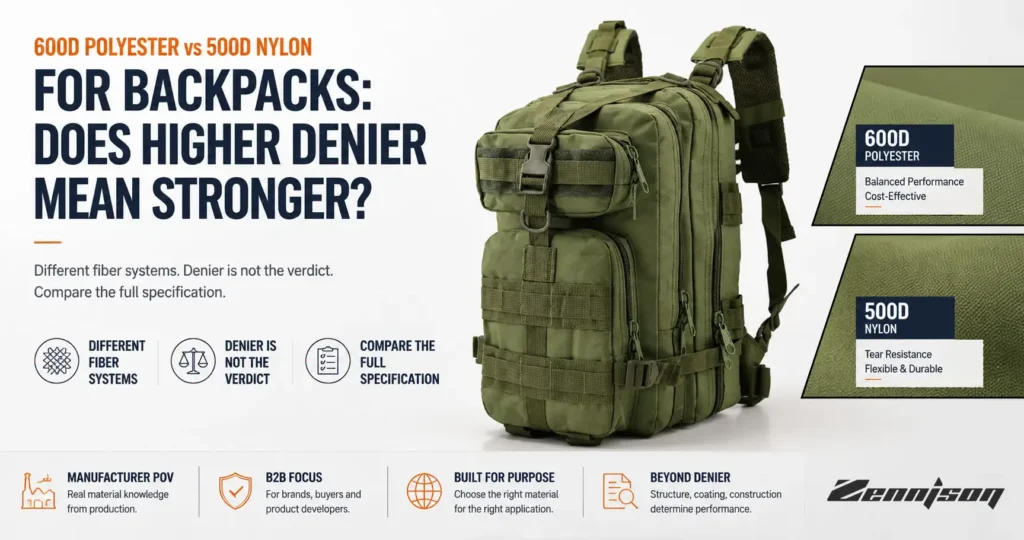
A buyer comparing 600D polyester with 500D nylon may see an obvious answer in the numbers: 600 is greater than 500, so the 600D fabric must be stronger.
That conclusion does not follow.
Denier describes one part of the yarn specification. It is not a strength score for a finished fabric, and it is not a quality grade for a complete backpack. In this comparison, the fiber system changes from polyester to nylon at the same time as the denier changes. The finished fabrics may also differ in yarn quality, weave, weight, coating, finish, and intended use.
For an OEM backpack project, the useful question is not “Which number is higher?” It is “Which complete material specification fits the job, and what evidence supports that decision?”
Our approach is simple: define the job first, compare the complete fabric specifications second, and treat denier as one variable—not the verdict.
The Short Answer: 600 Is Not Automatically Stronger Than 500
The “D” in 600D and 500D belongs to the yarn specification. It helps describe yarn linear density, but it does not tell a buyer how the finished fabric was woven, how heavy the finished material is, what coating was applied, or how the material performs under a specified test.
This matters because 600D polyester and 500D nylon are not two versions of the same fabric with only one number changed. They use different fiber systems. If a supplier also changes the yarn source, construction, finished weight, coating, or finish, several variables are moving at once.
Under those conditions, neither of these statements is reliable:
- 600D polyester is stronger because 600 is the larger number.
- 500D nylon is stronger because nylon is automatically the better fiber.
Either fabric can be the appropriate design choice when its complete specification matches the backpack requirement. Neither label, on its own, proves abrasion performance, tear strength, tensile strength, water resistance, or finished-product durability.
To make a performance comparison, buyers need two defined materials, a relevant test method, and results that apply to those exact materials. Until those conditions are in place, the honest conclusion is not that the materials are equal. It is that the denier labels alone do not settle the question.
Why Denier Cannot Settle a Polyester-vs-Nylon Comparison
Denier becomes misleading when it is treated as a complete material description. A useful fabric decision requires more than a yarn-size label.
Consider what can change between two backpack fabrics:
- the fiber system;
- yarn quality and yarn construction;
- weave and overall fabric construction;
- finished fabric weight;
- backing, coating, or laminate;
- surface finish and water-repellent treatment;
- hand feel and stiffness;
- color and colorfastness requirements;
- the test method used to evaluate performance; and
- the location where the fabric will be used.
If these variables are not controlled or disclosed, a buyer cannot attribute a difference in the finished materials to denier alone.
This is especially important in a cross-fiber comparison. The buyer is not asking whether a 600D yarn is numerically larger than a 500D yarn. The buyer is trying to predict how two finished fabrics will behave in a specific backpack. Those are different questions.
The same distinction applies to water requirements. Denier does not define whether the buyer needs a surface water-repellent finish, a coated backing, or a more complete water-management construction. Those requirements must be stated separately and then reflected in the selected material and product design.
For procurement teams, the practical lesson is to stop using the denier label as shorthand for several unspoken expectations. If the project requires a particular performance, specify that requirement directly. Then ask the supplier to identify the material construction and evidence used to meet it.
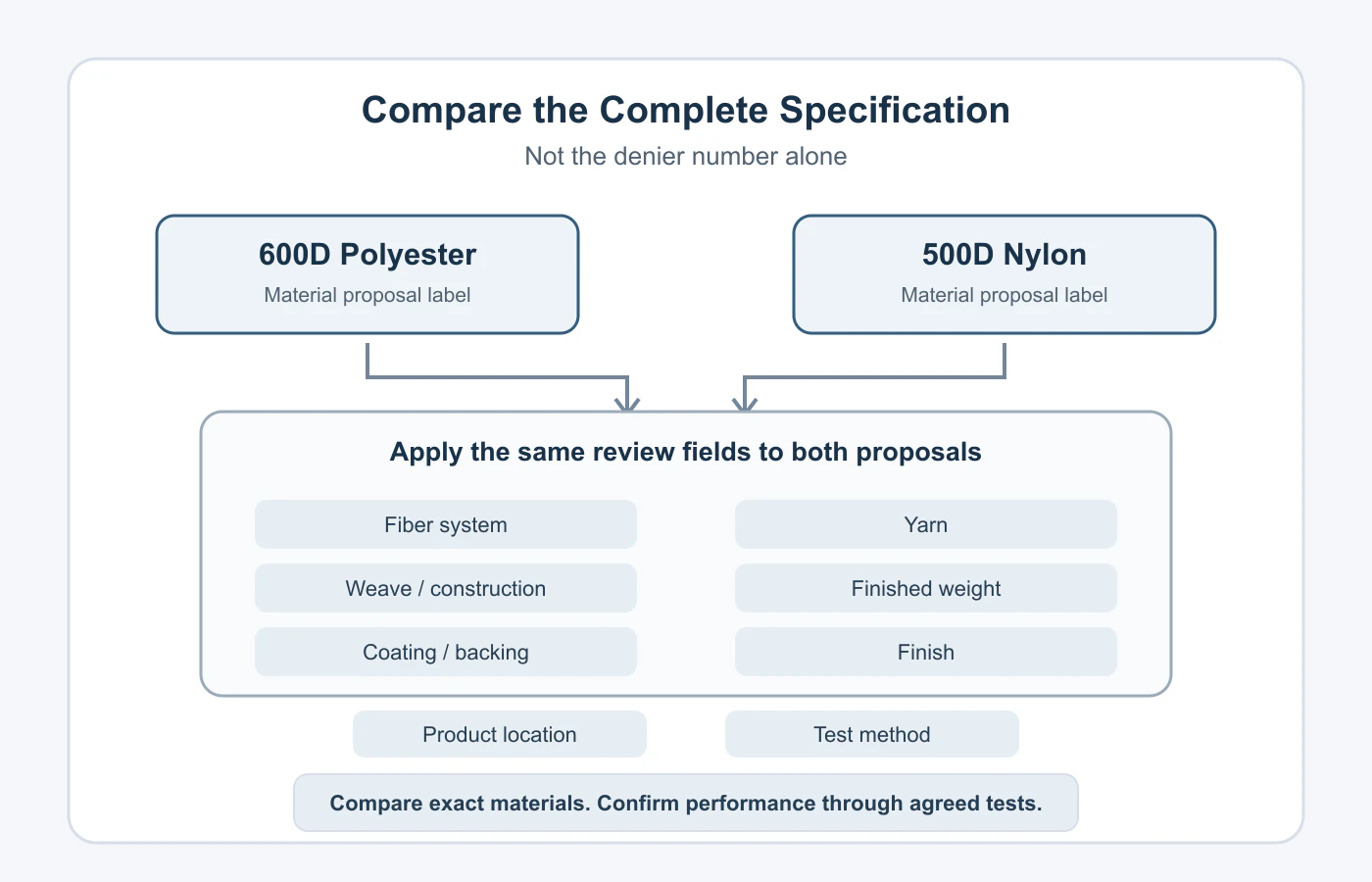
What a Like-for-Like Comparison Must Include
A controlled comparison does not require every backpack project to use the same specification. It requires the buyer and supplier to make the changing variables visible.
Start with the following fields.
Fiber and yarn
Confirm whether the proposed material is polyester, nylon, or another fiber system. Record the yarn information available from the supplier rather than assuming that all yarns with the same denier are interchangeable.
Fabric construction and finished weight
The weave and complete construction help determine how the yarns form the finished fabric. Finished fabric weight adds another useful control because two fabrics carrying similar denier labels can still be built differently.
Coating and finish
Identify the backing or coating, the surface finish, and the water requirement they are intended to address. “Water resistant” is too broad for a controlled specification unless the buyer defines what the product must do and how that requirement will be evaluated.
Hand feel, stiffness, and product location
A fabric must work inside the product, not only as a swatch. The required hand and stiffness should fit the bag’s shape, opening, seam construction, binding, foam, hardware, and intended user experience. The specification should also state where the material is used. A shell panel and an internal divider do not perform the same job.
Test method and acceptance requirement
If abrasion, tear, tensile, colorfastness, or water performance matters to the buying decision, name the required test or document. A result has meaning only when it belongs to the exact material and its stated test conditions.
This information does not create a universal winner between 600D polyester and 500D nylon. It creates a fair basis for comparing two real proposals. It also prevents a common purchasing problem: receiving two quotations that appear comparable because both mention a denier, while the underlying fabrics are materially different.
| Comparison field | 600D polyester proposal | 500D nylon proposal |
|---|---|---|
| Fiber system | Confirm from exact supplier specification | Confirm from exact supplier specification |
| Yarn information | Confirm from exact supplier specification | Confirm from exact supplier specification |
| Denier | Confirm from exact supplier specification | Confirm from exact supplier specification |
| Weave / construction | Confirm from exact supplier specification | Confirm from exact supplier specification |
| Finished fabric weight | Confirm from exact supplier specification | Confirm from exact supplier specification |
| Coating / backing | Confirm from exact supplier specification | Confirm from exact supplier specification |
| Surface finish | Confirm from exact supplier specification | Confirm from exact supplier specification |
| Hand / stiffness | Confirm in approved sample | Confirm in approved sample |
| Product location | Record in BOM | Record in BOM |
| Required test method | Define in RFQ | Define in RFQ |
| Acceptance requirement | Confirm through agreed test method | Confirm through agreed test method |
When Each Material Direction Enters the Discussion
The choice should be framed around project fit, not a low-to-high material ladder.
When 600D polyester enters the discussion
In our sourcing conversations, 600D polyester can be a practical starting point for commercial backpack projects that need to balance appearance, basic function, and target cost. That does not make it a “low-end” specification. It means the material direction can fit a defined commercial brief when the exact construction, coating, finish, and application meet the requirement.
The buyer still needs to review the finished fabric. A 600D label cannot confirm the weave, coating, stiffness, color performance, or suitability for a particular panel.
When 500D nylon enters the discussion
500D nylon becomes relevant when the project calls for a nylon material system and the team is evaluating factors such as product environment, finished weight, hand feel, structural compatibility, and target use. Do not select it merely because the fiber name is being treated as a quality rank.
The exact 500D nylon proposal must go through the same specification review as the polyester option. The fiber name does not remove the need to confirm construction, finish, location, and evidence.
The decision is contextual
The two materials represent different design directions. One does not have to be described as an upgrade from the other.
A buyer may choose either direction after considering:
- product positioning and target market;
- expected use environment;
- pack dimensions and capacity;
- external contact and wear exposure;
- water-repellent or coating requirements;
- desired appearance, hand, and stiffness;
- surrounding materials and construction;
- target cost; and
- required tests or documents.
This framework also avoids a different mistake: assuming that a larger bag or a higher expected load automatically needs a higher denier. Load influences the product specification, but the shell is only one part of the answer.
Turn the Backpack Requirement Into a Material Decision
When a buyer sends only “600D” or “500D,” the material discussion has started, but it is not finished. We need to understand the work assigned to the fabric.
First, define the product. Is it a promotional daypack, a commercial outdoor bag, a tactical pack, or another product with a distinct use environment? What size and shape must it hold? Which surfaces face repeated external contact? What appearance and hand should the finished bag have?
Second, separate the material questions:
- What must the shell resist during intended use?
- What level of water repellency or coated protection is required?
- How should the bag feel and hold its shape?
- Which panels or components use the material?
- Which test or document will confirm a buyer-critical property?
Third, separate shell requirements from structural requirements. Expected load matters, but it does not translate directly into a denier number. Shoulder roots, handles, attachment points, and support components introduce different questions about webbing, reinforcement, stitching, hardware, and force distribution.
Finally, compare proposed materials against the same brief. If one supplier quotes a coated 600D polyester and another quotes a 500D nylon with a different construction and finish, the buyer is not comparing denier alone. The quotation review should make those differences explicit and connect them to the intended product.
The result may be 600D polyester, 500D nylon, or a different specification. The value of the process is not that it always selects the same material. The value is that the recommendation can be traced back to the product requirement.
Why the Shell Fabric Does Not Decide Backpack Strength by Itself
Shell fabric contributes to the backpack, but concentrated load points depend on the surrounding structure. At a shoulder root or handle, we look at how webbing extends into the bag, how large the reinforcement area is, which material layers are connected, how the stitching joins them, and how force spreads into the body.
A heavier shell cannot rescue a weak load path. At the same time, good reinforcement does not make shell selection irrelevant. The two decisions solve different parts of the product.
Buyers concerned about carrying performance should therefore review both the exposed fabric requirement and the construction around load-bearing points. We explain this structural distinction in more detail in our guide to 500D vs 1000D fabric for tactical backpacks.
How to Make 600D and 500D Quotations Comparable
The best time to control this comparison is before suppliers quote and before the sample is approved.
In the RFQ
Give the supplier enough context to interpret the material request:
- product type and positioning;
- use environment;
- dimensions or capacity;
- expected load;
- external wear or contact conditions;
- water-repellent or coated-protection requirement;
- target market or cost direction;
- specified material brand, if required;
- required tests, reports, or compliance documents; and
- key functions of the shoulder, back, and support system.
This prevents the supplier from filling specification gaps with assumptions that differ from those used by other bidders.
In the BOM
Do not stop at “600D polyester” or “500D nylon.” Record the available specification fields, including:
- material and fiber name;
- denier;
- weave or construction;
- coating and finish;
- color or color reference;
- supplier or internal item reference;
- test or document requirement; and
- product use location.
The objective is not to make every BOM longer. It is to make the selected material identifiable and repeatable.
Illustrative Material Specification Template
This example shows the fields buyers may define when comparing material proposals. It is not a Zennison production BOM and contains no verified production values.
| Specification field | Illustrative entry |
|---|---|
| Component / product location | Buyer to specify |
| Material | Supplier to declare |
| Fiber system | Supplier to declare |
| Denier | Supplier to declare |
| Weave / construction | Supplier to declare |
| Finished weight | Supplier to declare |
| Coating / backing | Supplier to declare |
| Finish | Supplier to declare |
| Color / reference | Buyer to specify |
| Required test | Define agreed test method |
| Acceptance requirement | Define agreed test method |
| Approved sample reference | Confirm against approved sample |
In the approved sample
The BOM records what material has been selected. The approved sample shows how that material works with the rest of the backpack: folds, bindings, foam, webbing, hardware, reinforcement, and key seams.
A swatch can help compare surface and hand, but it cannot answer every product-level question. Review the material again after it enters the complete sample, then freeze the approved relationship between specification and construction before bulk production.
For buyers comparing suppliers, this creates a cleaner commercial decision. Quotations can be reviewed against the same product job, differences in the proposed fabrics become visible, and performance language can be tied to stated evidence rather than the larger denier number.
Choose the Specification, Not the Bigger Number
600D polyester does not defeat 500D nylon because 600 is greater than 500. And 500D nylon does not automatically outrank 600D polyester because it uses nylon.
The appropriate material emerges from the complete specification, the product location, the surrounding construction, and the evidence required for the project.
If you are preparing an OEM backpack RFQ, send us the product positioning, use environment, dimensions, expected load, water requirement, target cost, and required tests. We can review the material options as part of the complete backpack specification—without reducing the decision to one number.